
Storytelling can be done in many mediums. Movies, plays, operas, animated films, art and of course the written word are the main way we engage with a story. Poems short stories and novels rely on one thing and one thing alone and that is words. A novelist is armed with only one tool – words. There is no musical help or visual art that can help the novelist. He or she must create everything with only one medium – words.
I say this because the opening of your book must have the words that you choose arranged in such a way as to make music, or become visually stimulating, or to be heartfelt the way a piece of art might make you feel.
I think that is the reason I was editing and revising the first paragraph and the first five pages of my book right up until the time I decided to print it and release it the world.
So let’s put it all together and then we can discuss the first line(s) in the opening of my book.
One: come up with a good or a great or striking premise.
Two: do an internal investigation to see if you have the basic skills of a writer. This would be evident if you are a good reader, if you have been writing or journaling on your own and if you know how to write a good sentence and if you have any sort of love or liking to words.
Three: rely on your intuition.
Four: start writing what you know but do not end there.
Five: try hard not to be a self-insert in your story. A part of you will show up in one or more characters and it should but if you are to be truthful to the story, try to remove yourself completely so that you can focus your entire energy on your characters.
Six: Find your voice. Every writer has a distinct voice.
Seven: Write like you mean it. When I was first starting in the lawn care business I became a professional ‘lawn boy’ very quick. What I mean is that even though I only had a small number of clients I decided to serve them as best as I could. I showed up on time, I cut their yard with care and I expanded my client list and my knowledge of the business. When you are writing you must do the same thing. You must show up on time, give it your best at that time and grow in your knowledge and craft. Practice does not make perfect but it does make you better. After all, even the best footballers fumble the ball. You will be surprised how your skill will increase from the time you first start writing to the time you finish your story. And that is just the first draft.
Eight: I know this may come as hard advice for some of you but after you finish your first draft, put it in a drawer, walk away for three months and don’t look at it. Read, write, watch a movie, live your life but do not look at your manuscript. Wait. After three months pull it out and read it as if you are reading it for the first time. You’ll be surprised what three months will do.
Nine: Now it is time to revise. I won’t get into this right now because I will save editing and revising for another lesson.
This should be enough to take another look at the opening of your manuscript and now we will look at mine. Just in case you may have forgot there is a brief prologue that establishes my voice right before the first chapter. I will insert it below as a reminder.
Many people throughout the world have heard the name Nathaniel Hancock, but not everyone knows the whole story; the details, the little things and the history that has led up to his coming and his ascent into greatness. Those things have gone unnoticed, and for a time, unappreciated. What you are about to read is the full narrative of his life and the events that have come to shape the Inkworlds, and the New Renaissance as you know them today.
His story was set in motion somewhere southwest of Boston, Massachusetts…
What this prologue does is establish me, the author, as the credible witness to Nathaniel. This means that going forward there are no more doubts on who he is and what the story is about. I know the story inside and out and I am now going to convey it to you, the reader, in an authorative story form through personal narrative in my chosen style. Let’s begin with the first four paragraphs starting with the first sentence.
His fortress was an old abandoned factory once used for bottling soda. The woods near the train tracks encompassed his kingdom, and the basement in his home he imagined as the dungeon, with his dad’s tool pegboard as the armory. The attic housed the tower guard that protected his courts, and he ruled the town square with truth and justice. Mostly, Nathaniel Hancock explored thick backwoods and creek beds near the baseball fields on the way home from school. He always felt the need to kill a few goblins and expand his kingdom after math class.
One day he thrust his sword into the belly of a beast, and it fell at his feet breathless, lifeless — the roaring and gnashing of teeth silenced. The battle diminished, and one more intruder was laid waste before the might of the great throng. The king and his men returned home from the hunt after a long time patrolling the edge of his lands, and the applause of his subjects thundered for days.
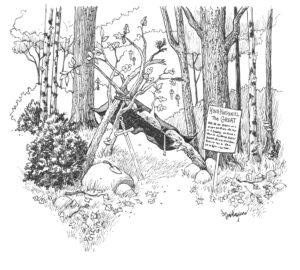
Over time, Nathaniel built an outpost using branches, connecting them with viny growths winding through the brush. He hid a few keys in a few trees and filled his fort with articles of rope, small hand tools, and his trusty sword. Large plastic bags were cut down the center and spread open to make a rain-proof roof.
This was his secret fort. In fact, it was so secret that he kept it hidden from all his friends, even his closest friends; even Juli. He made a sign for the front using cardboard he found in the neighbor’s trash. It read:
Stop here, and let’s go back to the first sentence.
His fortress was an old abandoned factory once used for bottling soda.
I wrote this sentence because I wanted to pull the reader into Nathaniel’s environment and his imagination at the same time. The reader now knows that the story is about a boy not a girl and the boy explores and pretends the abandon factory is his fortress. Young readers enjoy the thought of abandon buildings like castles or old houses and in this case a factory used for bottling soda. And the fact that the boy imagines it as his fortress implies that he is using his imagination to pretend that something ‘concrete and visible’ is something else entirely. So right from the very beginning you are brought into the interior of his mind. From that sentence we are going to build on that thought.
The woods near the train tracks encompassed his kingdom, and the basement in his home he imagined as the dungeon, with his dad’s tool pegboard as the armory.
The woods which is a part of his ‘real’ environment is transformed into his kingdom which adds to his fortress. The basement is now the dungeon and his dad’s tool pegboard is the armory. Now with only two sentences you have a parallel that is being established simultaneously. I am introducing you to the boy’s environment and showing you how he sees his environment. This dualistic way of storytelling will give you the personal insight of a first-person novel while remaining in third-person narrative which gives me the narrator a lot more options and frees me to do things with words that first-person narration does not allow. It gives me the option to pan up and down, backwards and forwards, and enables me to stay in closed third-person or widen it to third-person omniscient. I am only bound by the rules of the story. I cannot break those.
The attic housed the tower guard that protected his courts, and he ruled the town square with truth and justice.
The third sentence in the paragraph does two things. It expands his environment and imagination with the attic and the town square and it gives a further insight into his heart and thought life. He rules with truth and justice. Now we know he likes or honors truth and justice but we also know something more – he rules. This is the first sign that he is thinking on a personal level that he controls what goes on in his world – his imaginary world.
Mostly, Nathaniel Hancock explored thick backwoods and creek beds near the baseball fields on the way home from school.
This sentence is the main clarifier in the paragraph. By this time the reader knows all about his environment and the reader also knows that what he does most of the time is hike and explore in the woods near the baseball fields. This keeps the boy pressing his curiosity at the same time allowing him to be close enough to the baseball fields so as not to go too far into the woods. The baseball fields serve as a marker between the known and the unknown.
He always felt the need to kill a few goblins and expand his kingdom after math class.
The final sentence ends with his imagination versus math. Math is exact, imagination is free. Math works with numbers, imagination needs freedom. There is a right and wrong answer with math, imagination is subjective. And of course he has to kill a few goblins to keep his ‘kingdom’ free from intruders. This sentence completes the thought to get the story going and it also serves as a foreshadow of things to come.
I will breakdown my thoughts concerning the following three paragraphs in the next post.
)