
Now that we have discussed the first sentence and the first paragraph, let’s move on to the following three paragraphs. After that we will skip a few paragraphs to the inciting incident which we will spend a few lessons on. I only mention that because most people agree the inciting incident is where the story begins. The story can begin there but it can also begin with creating the atmosphere. I will share my thoughts on that when we get there.
One day he thrust his sword into the belly of a beast, and it fell at his feet breathless, lifeless — the roaring and gnashing of teeth silenced. The battle diminished, and one more intruder was laid waste before the might of the great throng. The king and his men returned home from the hunt after a long time patrolling the edge of his lands, and the applause of his subjects thundered for days.
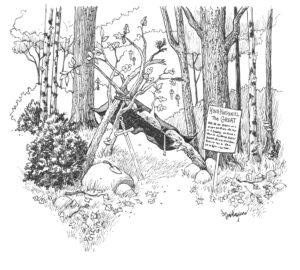
Over time, Nathaniel built an outpost using branches, connecting them with viny growths winding through the brush. He hid a few keys in a few trees and filled his fort with articles of rope, small hand tools, and his trusty sword. Large plastic bags were cut down the center and spread open to make a rain-proof roof.
This was his secret fort. In fact, it was so secret that he kept it hidden from all his friends, even his closest friends; even Juli. He made a sign for the front using cardboard he found in the neighbor’s trash. It read:
Here are my thoughts on these paragraphs: I wanted to bring the reader in further into Nathaniel’s imagination and what appears to be his longing or need for praise. I wanted the reader to know that killing goblins, patrolling his lands and receiving praise was a part of his every day life. This was nothing new to him.
How many young boys play Star Wars or Commando or Cowboys and Indians or some other imaginary game as they grow up? I am not sure how common it is in other countries but many boys in the U.S at some point play in the imaginary world where they are the hero or they are on the winning side of a battle or war or game. This imaginary play is central to the development of young boys. Some boys take it further than others and as we can see here, Nathaniel takes it to the extreme and he does so most of his spare time. It is almost as if the imaginary world is more real to him than the real world. By now the reader should know that most things that he sees are with an imaginary twist, blurring the lines between reality and what is later called Imaginative Reality (I will do a blog series on Imaginative Reality at some point).
As we read through the following paragraph we discover that Nathaniel does not only have an imagination he is pretty self-reliant and kind of a hands-on boy in that he can make use of things in his surroundings to fit his own purpose. I am reminded of the television show I grew up watching called, The Little Rascals. Those kids built a fort, a race car and all kinds of things using garbage or little things they found or other items that would be considered useless. This gets into the thought, ‘write what you know.’ All I did was take that as an example from my childhood. I also made several forts growing up and I always loved finding keys or shotgun shells. I figured if Nathaniel was like me or most boys, he would do the same kind of things given the opportunity. This paragraph gives us more insight into who he is a young boy pulling the reader into his world. This must be done quickly because I do not want to bog the reader down with a lot of back story.
The next paragraph will be the crown of The Opening. Let’s go over it again another time before I add my commentary.
This was his secret fort. In fact, it was so secret that he kept it hidden from all his friends, even his closest friends; even Juli. He made a sign for the front using cardboard he found in the neighbor’s trash. It read:
I had the second sentence already written in another paragraph so I had to switch it up and put it here and I added the first sentence after nearly sixteen years of completing all eight books. I revised this paragraph again and again countless times. This is where a strong love for words, love of story, knowledge of story, and maximum efficiency all come together at the same time. How could I reveal that Nathaniel wasn’t a loner? That was the question that haunted me. I did not want to go into a broad description of his friends because that would only slow the story down. I needed something – a sentence that would carry the weight of Nathaniel’s history and hierarchy in the social chain.
I had to do some thinking. I often look back on my life and see if I can pull something from it – anything – a conversation, an experience, a friend, a book I read; anything will work if I can have the right thought. I can always change the context to fit the story.
A lightbulb…
I remember when I was thirteen; a friend and I discovered a cabin in the woods. We rode our bikes all the way to where the suburbs ended and the vast Central Texas hill country began. We peered over two hills and decided that the following day we would pack our backpacks correctly (we were Boy Scouts at the time so we were very knowledgeable about bringing the right stuff on a hike). Then we set off and hiked over the two hills and when we were in the second valley we saw a cabin in the woods. To make a long story short, we discovered it – it was our cabin the entire summer until my friend went against our pact and told a friend, then he told a friend and one day our cabin was no longer ours but everyone’s in the neighborhood. I was furious. I think that is where this sentence comes from, only it’s not a cabin in the woods but a fort Nathaniel built. Kind of the same sentiment – different context.
This sentence establishes that Nathaniel built a secret fort, and he kept it secret from all his friends noting his popularity, even his close friends – meaning there is a group within the group and there is Juli. It shows that Nathaniel went to great lengths to keep his fort a secret fort, far from prying eyes and he wasn’t going to let anyone know about it. In my mind it is a stand-out sentence. In fact, in an upcoming lesson I am going to write about stand-out sentences and why they are important. This sentence does something else. It names Juli in such a way as being the most important person to him in this group. First there are the friends, then the closest friends, even Juli. I put the emphasis on Juli by naming her. Now the reader will know that she will appear later in the story.
So that’s it. That is the first five paragraphs to the opening of my fantasy series. I started with what I knew. I pulled the reader in to Nathaniel’s world – his physical and imaginative world. I set up the scene of entry, established a narrative tone, gave the reader some information on who Nathaniel is and now I will further clarify his family and create the inciting incident. That will be reserved for the next lesson.
This is where you have to decide what kind of opening you want. Whatever it is you must show and tell these things within the first five paragraphs. You must give us a setting, a character(s), a sense of the story and finally, probably the most important, you must give the reader a reason to care.
)